




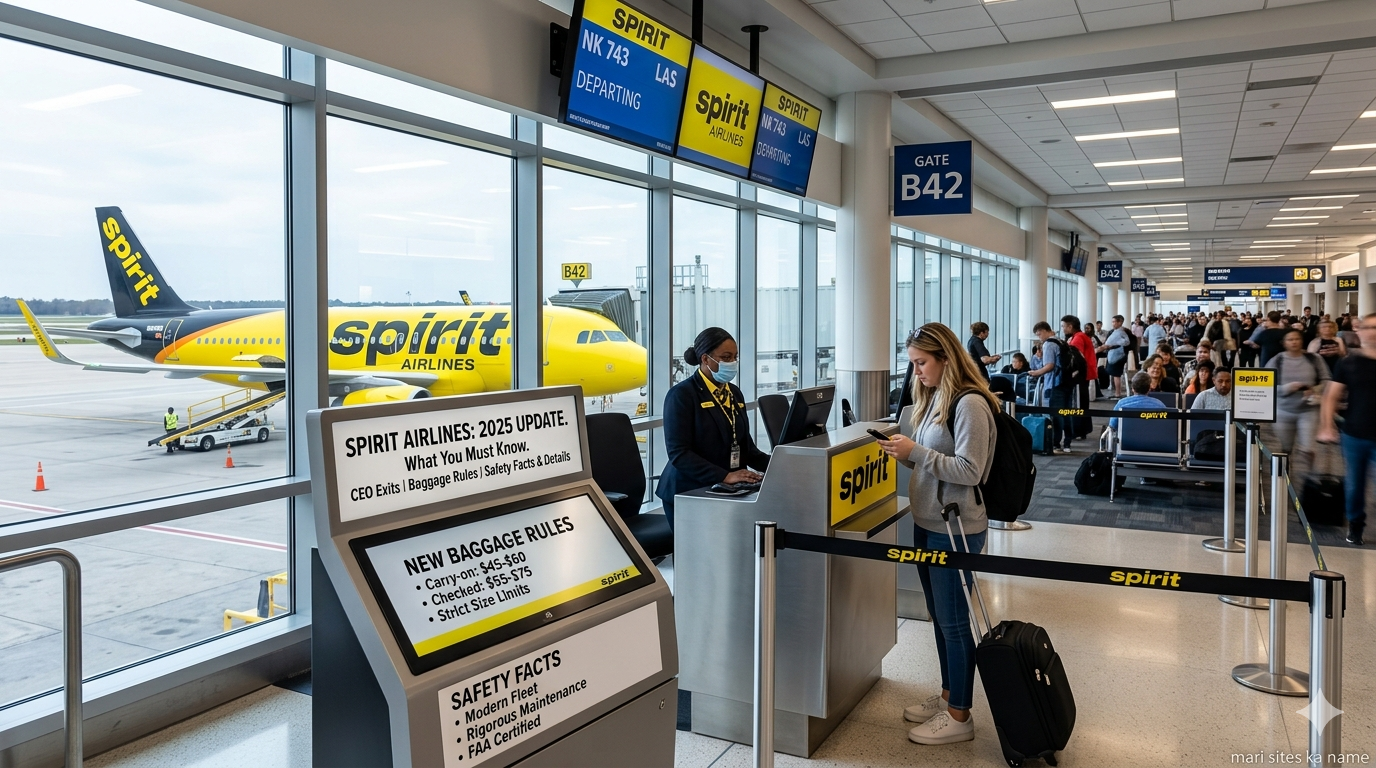
If you’ve ever searched for a cheap flight, chances are Spirit Airlines popped up first. The bright yellow planes are hard to miss. Spirit is known for super low base fares, strict bag rules, and a no-frills flying experience. But lately, Spirit Airlines has been making news for a lot more than cheap tickets. Their CEO stepped down. They filed for bankruptcy. People keep asking, “Is Spirit Airlines safe?” and “What can I actually bring for free?”
This guide answers all of that. We cover the Spirit Airlines CEO Ted Christie resignation, the Spirit Airlines personal item size rules, safety records, and much more. Whether you’re a first-time Spirit flyer or a budget travel pro, this article is for you. Let’s break it all down in plain, simple English.
What Is Spirit Airlines? A Quick Look at the Brand
Spirit Airlines is an American ultra-low-cost carrier (ULCC). That means they offer very cheap base ticket prices but charge separately for almost everything else — bags, seat selection, snacks, even printing your boarding pass at the airport. Spirit was founded in 1983 and started as a trucking company. It became a full airline by 1992. Their head office is in Miramar, Florida.
Spirit flies to over 70 destinations across the United States, the Caribbean, Latin America, and Central America. Their fleet is made up mostly of Airbus A319, A320, and A321 planes. The airline targets budget-conscious travelers who are willing to skip extras to save on airfare. Their slogan has been “Less Money. More Go.” — which pretty much says it all about their business model.
Spirit Airlines CEO Ted Christie Resigns: What Really Happened?
One of the biggest stories in budget aviation recently was the news that Spirit Airlines CEO Ted Christie resigns. This came as a shock to many in the industry. Ted Christie had been a key figure steering Spirit through turbulent times, including a messy merger battle with Frontier Airlines and JetBlue. When those deals fell apart, Spirit was left in a difficult financial position.
Ted Christie officially stepped down in November 2024, right as Spirit Airlines filed for Chapter 11 bankruptcy protection. His exit was seen as both a result of the financial struggles and a way to reset leadership for the next chapter of the airline’s story. Let’s look at the full biography of Ted Christie below.
Ted Christie — Complete Biography Table
| Full Name | Edward M. “Ted” Christie |
| Role at Spirit | President & CEO (2019–2024) |
| Education | B.S. in Accounting, University of Vermont |
| Career Start | Joined Spirit Airlines as CFO in 2012 |
| Promoted to President | 2016 |
| Became CEO | January 2019 |
| Resignation Date | November 2024 |
| Reason for Resignation | Spirit Airlines Chapter 11 bankruptcy filing; leadership transition |
| Key Achievement | Oversaw rapid fleet expansion; negotiated (failed) mergers with Frontier & JetBlue |
| Known For | ULCC cost discipline, aggressive route network growth |
| Successor | Board-led transition team post-bankruptcy filing |
| Industry Experience | 20+ years in airline finance and operations |
| Nationality | American |
Ted Christie spent over a decade at Spirit before becoming CEO. Under his leadership, Spirit grew its fleet significantly and tried to expand through mergers. The Spirit Airlines CEO Ted Christie resigns news marked the end of an era for the airline. Many industry experts believe his tenure was defined by bold bets that ultimately didn’t pay off, especially after regulators blocked the JetBlue acquisition in 2024.
Spirit Airlines Bankruptcy: A Simple Timeline of Events
The Spirit Airlines bankruptcy story is complex, but here’s a clear, easy-to-follow breakdown of what happened and when. Understanding this helps you know what the airline’s future might look like — and whether your tickets are still valid.
2022
Frontier Airlines offers to buy Spirit. Deal later collapses after JetBlue makes a competing bid.
2022–2023
JetBlue acquires Spirit in a $3.8 billion deal. Regulatory battle begins with the DOJ.
Jan 2024
Federal judge blocks the JetBlue–Spirit merger, citing antitrust concerns. Deal officially cancelled.
Mid 2024
Spirit begins cutting routes, grounding planes, and seeking new financing options.
Nov 2024
Spirit Airlines files for Chapter 11 bankruptcy protection. CEO Ted Christie resigns.
Early 2025
Spirit continues operating under court supervision. Restructuring plan submitted to bankruptcy court.
Mid 2025
Spirit emerges from bankruptcy with slimmer fleet and reduced workforce. New leadership in place.
Chapter 11 bankruptcy does NOT mean the airline shuts down immediately. Spirit kept flying during this period. However, always check your booking directly with Spirit if you have upcoming travel plans.
Spirit Airlines Personal Item Size: What Fits for Free?
One of the most Googled questions about Spirit Airlines is: “What size personal item can I bring for free?” This is super important because Spirit charges for carry-on bags, and those fees can really add up. Getting your personal item size right saves you real money at the gate.
Here are the official Spirit Airlines personal item size limits as of 2025. Your personal item must fit under the seat in front of you. It must not exceed these maximum dimensions:
Personal Item
18″ × 14″ × 8″
Max dimensions (L × W × H)
Carry-On Bag
22″ × 18″ × 10″
Paid add-on — not free
Checked Bag
62″ total
Linear inches (L+W+H), max 40 lbs
Overweight Fee
$50–$100
Bags over 40 lbs cost extra
The Spirit Airlines personal item size rule is strict. If your bag doesn’t fit under the seat, gate agents can charge you for a carry-on — and airport bag fees are always more expensive than pre-purchased bag fees. Pro tip: always buy your bag allowance online before arriving at the airport to save the most money.
Good examples of personal items that work: a small backpack, a purse, a laptop bag, or a tote bag. A standard school backpack usually fits fine as long as it’s not stuffed too full. If you’re packing smart and light, you can absolutely fly Spirit with just a free personal item and keep your ticket cost very low.
Read more: mod on trend
Is Spirit Airlines Safe? The Honest Answer
Is Spirit Airlines safe? This is probably the most important question for first-time flyers. The short answer is: yes, Spirit Airlines is a safe airline to fly. They meet all FAA (Federal Aviation Administration) safety requirements. All US airlines, including budget carriers, must follow the same federal safety rules. There’s no separate safety standard for cheap airlines.
7/7
AirlineRatings.com Safety Rating
Spirit Airlines has consistently received 7-star safety ratings from independent aviation safety auditors, indicating full compliance with all IOSA (IATA Operational Safety Audit) standards.
Spirit Airlines is certified under IOSA, which is the global gold standard for airline safety audits. The FAA also conducts regular inspections of US carriers. Spirit has never had a fatal crash in its commercial history. Their Airbus fleet is modern and well-maintained. The pilots and crew go through the same rigorous training programs as any other US airline.
That said, Spirit Airlines does have a reputation for delays and cancellations — particularly during its operational struggles in 2022 and 2024. On-time performance has been inconsistent. But delays are an operational issue, not a safety issue. You may be frustrated; you will not be in danger. So if you’re asking “is Spirit Airlines safe to fly?” from a physical safety standpoint, the answer is a confident yes.
Spirit Airlines Fees: What Will You Actually Pay?
Spirit Airlines operates on an “unbundled” pricing model. This means the base fare is very cheap, but you pay for almost every extra. Here’s what you need to know to avoid sticker shock at checkout. Understanding the fee structure is key to deciding if Spirit is worth it for your trip.
The biggest fees to watch out for include: checked bag fees (which start around $35 when booked in advance and go up to $100+ at the gate), carry-on bag fees (which start around $40 online and can be $79 at the gate), seat selection fees (which range from $5 for a basic seat to $50+ for a Big Front Seat), and even a charge for printing your boarding pass at the airport ($25 in 2025). Always check in online and use the app to save money at every step.
Spirit Airlines Big Front Seat: Is the Upgrade Worth It?
Spirit Airlines doesn’t have a traditional first-class section, but they do offer something called the Big Front Seat. These seats are at the front of the plane and are significantly more spacious than standard seats. The Big Front Seat offers about 36 inches of pitch and 20 inches of width — which is comparable to business class on many other airlines.
Prices for the Big Front Seat vary a lot depending on the route and how far in advance you book. You might pay anywhere from $12 to $100 extra for one of these seats. If you’re a taller person or just want more comfort on a longer flight, this upgrade can be a great value compared to buying a business class ticket on a legacy carrier. Keep an eye out for deals on these seats during Spirit’s regular sales events.
Where Does Spirit Airlines Fly? Popular Routes in 2025
Even after the bankruptcy restructuring, Spirit Airlines still covers a solid network of destinations. Their focus is heavily on leisure travel routes — think beach destinations, theme park cities, and sun-belt getaways. Spirit is especially popular for domestic routes within the US where driving would take too long but full-price flights feel too expensive.
Top Spirit Airlines routes include: Fort Lauderdale (their main hub) to New York, Chicago, and Atlanta; Las Vegas to cities across the West Coast; Orlando to Boston and Philadelphia; and international routes to Cancún, Montego Bay, and San Juan. After exiting bankruptcy, Spirit has trimmed some less profitable routes and doubled down on their strongest markets. Check their website directly for the most current route map and any new additions.
10 Smart Tips for Flying Spirit Airlines Without Stress
Flying Spirit Airlines doesn’t have to be a headache. The people who love Spirit are the ones who understand the rules and plan ahead. Here are ten practical tips that can make your Spirit experience much smoother and cheaper.
First, always book bags online when you buy your ticket — the price jumps significantly if you add them later or at the gate. Second, download the Spirit app and check in online 24 hours before your flight to get a free boarding pass. Third, pack light and use only your free personal item if possible — this keeps your cost as low as the advertised base fare. Fourth, join the Spirit Saver$ Club if you fly Spirit more than twice a year, as the membership pays for itself quickly. Fifth, always set fare alerts for your route because Spirit runs surprise sales that can cut prices dramatically. Sixth, arrive at the airport early because Spirit’s check-in lines can be slow, especially at busy airports. Seventh, bring your own snacks and an empty water bottle to fill after security — everything on board costs extra. Eighth, read your boarding zone so you know when to line up. Ninth, check your flight status the night before in case of schedule changes. Tenth, stay calm at the gate — Spirit’s customer service can be inconsistent, and a polite approach always gets you further.
What Is the Future of Spirit Airlines?
After emerging from Chapter 11 bankruptcy in 2025, Spirit Airlines is in a period of rebuilding. The airline has a smaller fleet, a leaner cost structure, and new leadership guiding the way forward. Industry analysts are watching closely to see if the ultra-low-cost model can survive in today’s competitive environment where larger carriers like Southwest and American have gotten more aggressive on pricing.
Spirit’s biggest challenge ahead is winning back customer trust. The combination of operational meltdowns in recent years, the failed JetBlue merger, and the bankruptcy filing have hurt the brand’s reputation. However, Spirit still has a loyal base of budget travelers who don’t want to spend more than they have to. If the airline can deliver reliable service at its trademark low prices — and be transparent about its fees — there is still a real market for what Spirit offers. The next 12 to 18 months will be critical for the airline’s long-term survival.
Frequently Asked Questions About Spirit Airlines
Final Thoughts: Should You Fly Spirit Airlines?
Spirit Airlines is not for everyone — and they know it. It’s a trade-off. You give up comfort, flexibility, and freebies in exchange for a genuinely low base fare. If you pack light, plan ahead, and understand the fee structure, Spirit can save you a lot of money. If you show up unprepared with an oversized carry-on and no digital boarding pass, you’ll end up paying more than you expected.
The Spirit Airlines CEO Ted Christie resignsion and bankruptcy news were major events, but they don’t mean Spirit is disappearing. The airline is rebuilding. The Spirit Airlines personal item size rules are strict but simple once you know them. And when people ask “is Spirit Airlines safe?” — the answer is yes, backed by real safety data and federal oversight.
Have you flown Spirit Airlines? Share your experience in the comments below. And if this guide helped you, consider bookmarking it for your next budget trip. Safe travels!
References & Sources
- Federal Aviation Administration (FAA) — faa.gov — US airline safety regulations and certification standards
- Spirit Airlines Official Website — spirit.com — Baggage policies, personal item size rules, fee schedules (2025)
- AirlineRatings.com — Independent airline safety ratings, IOSA certification database
- U.S. Department of Justice — United States v. JetBlue Airways Corp. (2024) — Antitrust ruling blocking Spirit–JetBlue merger
- U.S. Bankruptcy Court, Southern District of New York — Spirit Airlines Chapter 11 filing, November 2024
- IATA Operational Safety Audit (IOSA) Registry — iata.org — Spirit Airlines certification record
- Reuters, Bloomberg, The Wall Street Journal — News coverage of Spirit Airlines CEO Ted Christie resignation, 2024
- Bureau of Transportation Statistics (BTS) — bts.gov — US airline on-time performance data
About the Author